
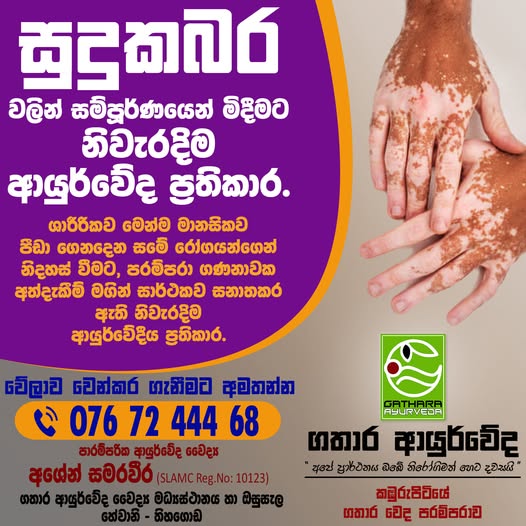
🔴 VITILIGO – සුදුකබර 🔴
Vitiligo, also known as Shwitra / Shwetha Kushta in traditional terminology, is a long-term skin condition in which the normal skin colour is lost, resulting in the development of white or pinkish patches on the skin. This occurs due to a loss or reduction of melanin, the pigment responsible for skin colour.
Vitiligo can affect any part of the body, but it commonly appears on the face, neck, hands, and skin folds. Areas affected by vitiligo are more sensitive to sunlight, so appropriate sun protection is important when spending time outdoors.
🔵 Common Signs & Symptoms
Vitiligo commonly affects areas such as:
👉🏻 Around the mouth and eyes
👉🏻 Fingers and wrists
👉🏻 Armpits
👉🏻 Groin
👉🏻 Genital areas
It can sometimes affect the scalp and hair follicles. When this happens, the hair in the affected area may also become white or grey.
Vitiligo often begins as a pale patch that gradually becomes completely white. The patches may have smooth or irregular borders and can sometimes appear slightly pinkish or darker depending on the individual’s skin tone.
Vitiligo usually does not cause dryness or significant discomfort, although occasional itching may occur.
The condition varies from person to person. Some individuals may develop only a few small white patches, while others may have larger areas of depigmentation.
🔵 Types of Vitiligo
There are two main types:
👉🏻 Non-Segmental Vitiligo
👉🏻 Segmental Vitiligo
In rare cases, vitiligo may affect almost the entire body. This is known as Universal Vitiligo.
🔵 Non-Segmental Vitiligo
This is the most common type of vitiligo. White patches often appear symmetrically on both sides of the body.
Common areas include:
👉🏻 Back of the hands
👉🏻 Both hands
👉🏻 Skin around body openings such as the eyes
👉🏻 Knees
👉🏻 Elbows
👉🏻 Feet
🔵 Segmental Vitiligo
In this type, depigmentation is generally limited to one particular area or side of the body. It is more commonly seen in children, although non-segmental vitiligo is more common overall.
🔵 What Causes Vitiligo?
Vitiligo occurs when the skin loses melanocytes — the cells responsible for producing melanin, the pigment that gives the skin its colour.
When melanocytes are lost or damaged, the affected areas can develop white patches. Hair in these areas may also lose its colour.
🔵 Autoimmune Factors
Non-segmental vitiligo, the most common form, is generally considered to have an autoimmune component.
In autoimmune conditions, the immune system mistakenly attacks healthy cells and tissues. In vitiligo, the immune system can target the melanocytes responsible for producing melanin.
🔵 Other Factors Associated with Vitiligo
Possible contributing or triggering factors may include:
👉🏻 Significant physical or emotional stress
👉🏻 Severe sun exposure or skin injuries such as cuts
👉🏻 Hormonal changes, including those occurring during puberty
👉🏻 Certain underlying health conditions
👉🏻 Exposure to certain chemicals
❗ Vitiligo is NOT contagious and cannot be spread from one person to another through physical contact.
People living with vitiligo may also experience reduced confidence, self-esteem concerns, stress, or emotional difficulties, particularly when the affected areas are highly visible.
✅ Vitiligo can be assessed and managed through appropriate medical care. Traditional Ayurvedic medicine also offers treatment approaches for this condition. Consult a qualified Ayurvedic physician for a proper assessment and suitable treatment plan.
Traditional Ayurvedic Doctor
Ashen Samaraweera
Want treatment suited to your own needs?
Book a consultation